
Pudding, but slower

Recently, my daughter was in the hospital restricted to a liquid diet. On the list: Jell-o.
A familiar food that signifies comfort just by it’s name.
The first day she chose the lime gelatin. The second, a bowl of vanilla pudding.
I didn’t grow up eating homemade pudding. I grew up eating “fast” pudding—the kind that begins with a boxed mix. I imagine that most people have the same experience. In fact, I always equated that magical box mix as “homemade”—you have to add milk and cook it. That counts as homemade, right?
I remember watching my mother turn that magic mix into pudding on the stovetop. A different flavor every week. She’d whisk it together in a pan, then poured it while still warm into little white dessert cups, all lined up neatly on the kitchen counter. They waited there while we finished dinner, steam rising and the surface barely set.
After dinner, as we washed dishes, I would eagerly anticipate eating that still-warm treat. The next day, the cold leftovers were just as good. Often better. Underneath that wrinkled surface film was something creamy and comforting.
As a child, I was always happy to open my lunch box and see a can of Del Monte pudding. Actually, “happy” doesn’t begin to describe the joy I felt. It’s hard to be a kid and have to go to school all day. What’s in the lunchbox can make all the difference. A little bit of comfort in the middle of the day to soothe the soul.
Another family favorite was my grandmother’s Tapioca Pudding. Honestly, I was obsessed with it. It’s an unusual concoction that begins with a box of tapioca pudding. After making the pudding you mix it with a homemade soft-meringue and crushed pineapple. I haven’t had it since my grandma died over twenty-four years ago and yet, I swear I can still taste it.
Recipes like this were a big part of an era that pushed Jell-o molds and Jell-o salads as a food group. There were entire recipe books dedicated to Jell-o concoctions.
Jell-o is still a staple in the American diet, especially since they launched their products in portable plastic cups that travel anywhere. All kinds of gelatin and puddings are featured at the holidays, appear in school lunch boxes, and shine on party menus. My colonoscopy prep guidelines included Jell-o gelatin as an allowable food. My mother-in-law’s assisted living facility had pudding on the daily menu.
And always served bedside when illness arrives. My daughter’s recent hospitalization reminded me of that. Yes, even though it contains it’s fair share of sugar, it’s a pretty simple food that is easily digested.
Dare I say that Jell-o simply feels like home?
Despite this, I never thought of making pudding without a box mix. It never crossed my mind.
Then, I started a bakery—everything was made from scratch. I learned how to make pudding for Cream Pies and to stuff in cupcakes.
Eye opener.
The “magical mix” isn’t so magical after all. It’s simply an ultra-processed short-cut—sugar and starch bulked up with additives that replace real food, then finished with artificial flavors and colors.
That’s it.
It turns out homemade pudding isn’t mystical, difficult or time-consuming. Yes, it takes a little longer than popping a lid, and a few more ingredients than tearing open a box. But if Jell-o pudding feels like home, try making the slow version. The good thing about learning to cook from scratch is that you can control the ingredients. Reduce the sugar, or use the milk of your choice, even use a different type of thickening agent.
However you decide to make it, slow pudding is worth the effort. And it’s so much better than the pudding we’ve become accustomed to.
It teaches us something simple and enduring. Something my grandfather always said to me:
Anything worth doing, is worth doing well.
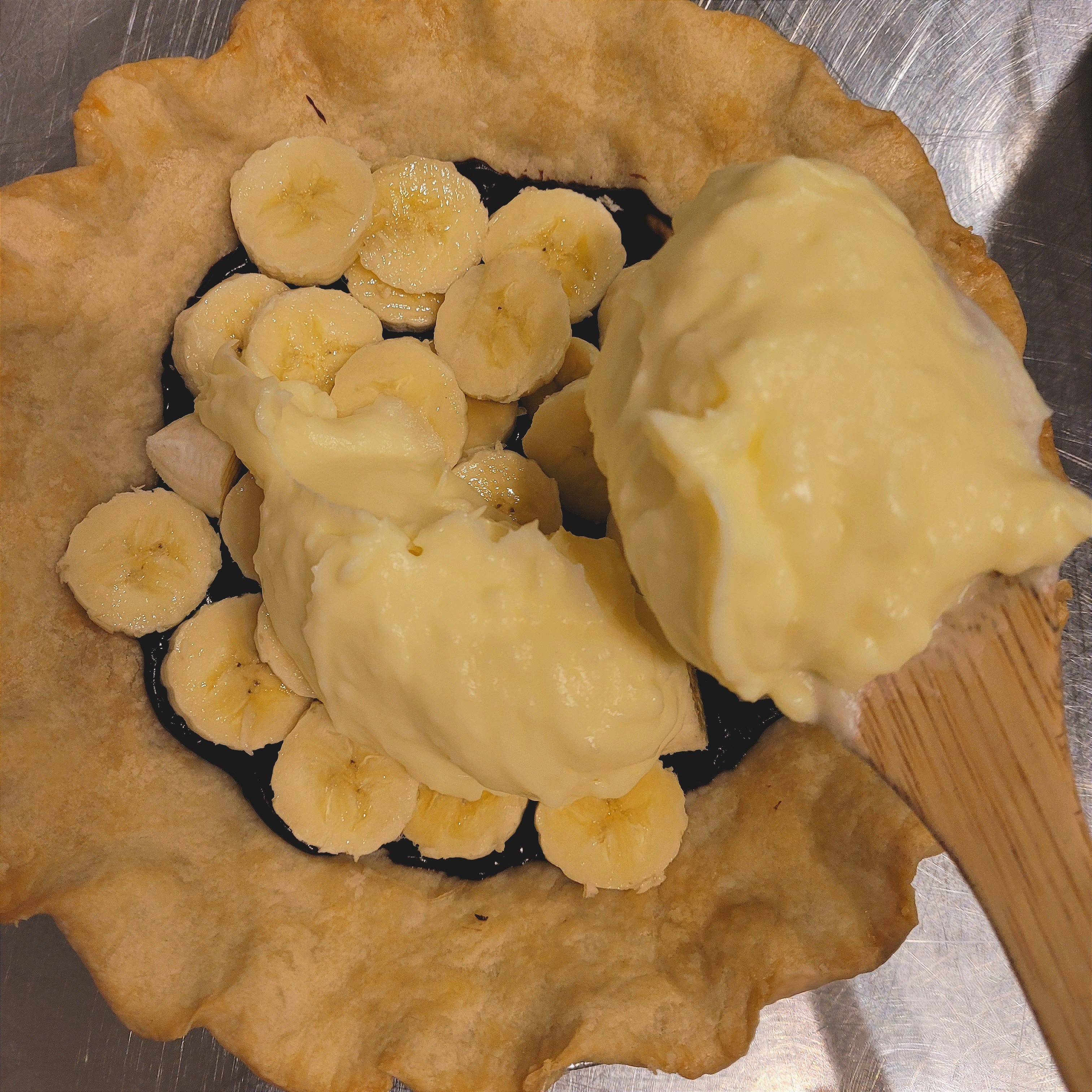
Vanilla Pudding
This pudding is the base for many custard pies, and you may hear it referred as “pastry cream”. It is the base of my Banana Cream Pie (and the picture above reflects me using it to assemble the pie.) The pudding is equally as wonderful on it’s own and is easy to adapt with flavors.
Ingredients:
1 C milk
1/2 C cornstarch
1 t salt
1 t vanilla
3 egg yolks
3 C milk
2 oz unsalted butter
2/3 C granulated sugar
Instructions:
Place first five ingredients in a bowl and mix until well blended.
Meanwhile, heat the milk, butter and sugar in a pan on the stovetop until milk is near scalding (don’t boil).
Add a ladle full of scalding milk mixture to the ingredients in the bowl. This is called “tempering” the eggs to prevent them from scrambling when you add them to the hot mixture. Mix to blend.
Add the entire contents of the bowl to the milk mixture on the stove. Continue to heat and stir constantly with a whisk.
The custard will begin to thicken. Switch to a rubber spatula and scrape the bottom of the pan to ensure the custard doesn’t stick and burn.
When the custard is thick and just begins to boil, it’s done.
Remove from heat. Pour through a sieve set over a bowl. Place in refrigerator to cool and set.
To prevent a film, cover with plastic wrap that sets directly on top of the surface. or don’t, some of us love the skin.
Note: If you prefer not to use cornstarch, arrowroot powder, tapioca starch or flour can be substituted. Choose what best fits your preferences.
Enjoy.
Warmly,
Michelle
What could you add/substitute to make white chocolate pudding?