
When Home Leaves
Tea Parties, Maple Cake and People Held the Center Together, until they left

My first tea party guests were my uncles. I grew up in my grandparent’s house surrounded by five of them. Typically my mom was gone—working or doing things young unmarried nineteen year olds do—so my uncles were my playmates. This means I learned to climb trees, deal cards and play Army men very well.
But when I wanted a tea party, they’d always oblige, especially my Uncle David and his new wife, Bobbie. I am not sure if it’s because I have photographic evidence to help lift the cobwebs, but I remember my small wooden table with the bear etched into it that we sat at. The chairs with the green and burgundy padded seats. The sunlight filtering into my playroom as I poured the little cups of real tea I begged my Grandma to brew.
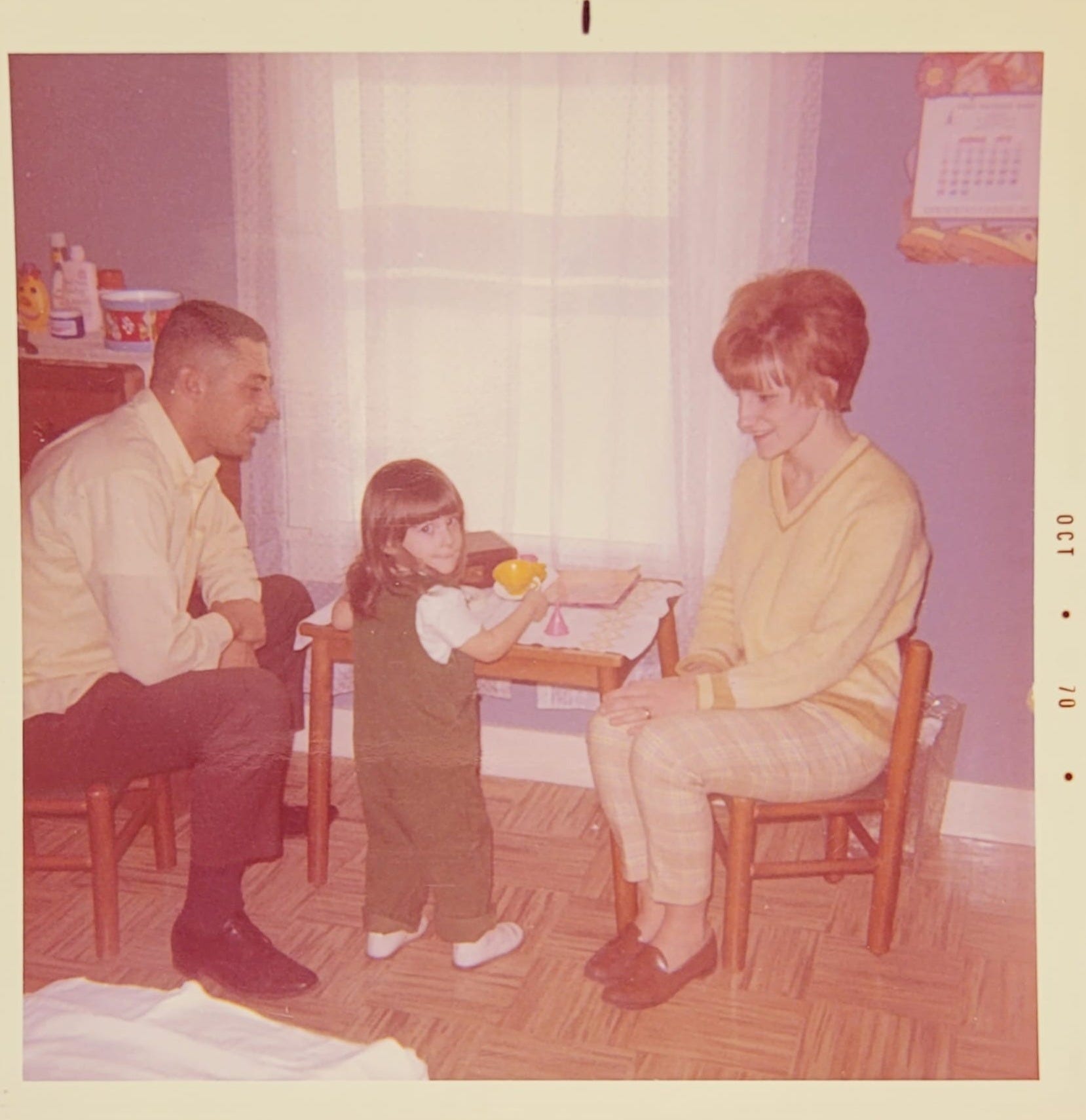
My uncles were larger than life to me. Each one impressive in his own right. There was nothing like the joy of being thrown on top of their shoulders so I could try and touch the ceiling, or climb a tree. They always obliged my “up, up, up” demands. I felt like I could soar right up to the sky when on their shoulders. The only thing that prevented it was my grandmother scolding them to put me down before I fell.
All of my uncles eventually found themselves in the services. Marvin, Donny and Denny in the Army; David in the Marines; Melvin in the Navy. Despite their absences, the fact that I was their first niece, the one they helped raise, meant we had developed a closeness that distance couldn’t fracture. But when they left, the house got a little quieter. The shoulder rides ceased and I turned to books instead of cards.
Exactly two years ago my Uncle David passed away. As the family was gathered sharing stories, my Aunt Bobbie told me how he wrote long letters from officer training. A stack of which she still has and reads often, achingly I am sure. Their love story is really one for the books. But sprinkled throughout those early letters he wrote were the questions asking how his niece was doing—wanting to know if she was growing like a weed, hoping she didn’t grow too fast while he was gone, marveling at her long hair from recent photographs. As my mom likes to tell me, I was born with a full head of hair that was rarely cut. Until the high school home perm and cut she gave me that ruined my life, but I digress.
Eventually Uncle David moved away permanently. College turned into Officer Training, a tour in Vietnam, and a base in Oceanside, California. Then employment as a CPA in Chicago, and its suburbs where he raised a family. My other uncles left as well. Different cities, different countries. Towards a life of their own and away from home.
My grandparents lived in a tall stone four square that had, at one time, been used as a sheriff’s office and jailhouse. To me, it was simply home. Even as I sit here and write about the house that no longer exists, I see it clearly in my memory. Every single inch of it. And by ‘no longer exists’ I mean that quite literally it was bulldozed and replaced with a strip of commercial businesses. Which makes this journey down memory lane even more bittersweet because I have nothing I can drive by and reminisce over, just the memories that live in my head. Although I am often accused of forgetting what I said a week ago, I remember my first home as if I was currently sitting on the gold couch, feeling the brown carpet underneath my feet as the lilac-scented breeze floats in through the window and moves the long curtains up and away from the floor they typically touch.
On days like this, the evening breeze was intoxicating. Although the house sat adjacent to one of the busiest roads in town, my grandfather had thoughtfully built a fortress of lilac trees around it, with an inner row of peony bushes. In one corner of the backyard was a tall willow tree. This is probably where my love of willows comes from. There was not a day that went by that I didn’t look out at that willow and the life it fostered. And in the summer, it sheltered our picnics or offered solace for spending an afternoon on a blanket with sun tea and books.
The house always seemed so large to me, especially from the willow view. But according to today’s standards it would fall on the smaller side. Perhaps it was the impressive walk-up attic that made it seem bigger. It was a four bedroom house, but only one bathroom and one large room for gathering. That same large room also housed a table at one end and served as the dining room for family dinners. It was also where my grandfather and I put endless amounts of jigsaw puzzles together, and spread maps all over the table when we were planning a vacation. It’s where my grandma taught me to play her favorite card games, and where we played records from the large record player that doubled as a buffet. It’s also where the family, when all home, gathered over our favorite desserts. One of those desserts was the beloved family-favorite Maple Cake.
It was a yellow cake with maple frosting, the sides completely covered in walnut pieces. We would make the trek into Chicago to obtain it from Dinkel’s Bakery every holiday season. We always purchased extra cakes for future gatherings, storing them in the basement freezer. It was a well-stocked working freezer, but one that could hold several cakes taken out of their boxes and carefully placed on the top shelf.
There was nothing like the anticipation of the Maple Cake. Over the years it had become synonymous with Christmas dessert. You'd begin thinking about it even before the stockings were hung. When Grandma pulled it of the refrigerator and set it on the counter, you’d hold your breath until it made its way to the dining table signaling it was almost time. There it sat—a beacon of love and togetherness. Soon after dinner the coffeepot would find its way to the table as well, cups stacked nearby, and that was when you knew it was time.
If my Uncle David was home, he was always the first to slice into the cake. As the eldest of six, no one questioned him. He’d smile and wave me over—like we were about to embark upon a secret mission. At his encouragement, I’d drag my finger through the thick maple frosting, the best part of the whole cake in my opinion. Creamy maple, as if a cinnamon roll had met a stick of butter and fallen in love.
Maybe it was the years of playing tea party, or embellishing my “one more book”. Whatever the reason, my Uncle David was always my quiet co-conspirator. Or was it because he was the eldest that helped him step into the father role a little more easy? Is that how he felt when he wrote those letters so long ago? I never thought about that until my Aunt shared with me how hard it was for him to leave his family when Basic Training called.
My Grandma died in 2001. Her death fractured the family. Before her death we gathered together for every holiday, birthday and general days that weren’t necessarily calendar-important. After she died, we didn’t. It was like a flip that switched suddenly and the light was extinguished. Which is why when we do gather, it’s one of the only times I feel truly at home. To be with the only people who knew “us” then.
As I’ve grown older, I’ve begun to understand something I couldn’t have known as a child sitting at that little tea table: leaving changes a family. It changes “us”. It changes home.
The world teaches us that growing up means going outward—college, cities, jobs, marriages, lives of our own. We call it success. Independence. Yet somewhere along the way the table grows quieter. The people who held the center begin disappearing. Holidays become reunions instead of ordinary Tuesdays. Home becomes something visited. The whole fractures when the pieces go out into the world again.
This is one reason I hesitate to leave my adult kids. I understand how it feels to be left. How quiet home gets. I also understand how it feels when the home is sold, or bulldozed, and there’s nothing left of it to visit. Or even drive by. I still have guilt over doing the leaving. I left for college and never returned. Now I live only an hour from my mom, and yet most days that is a distance that is still too far. An hour means you can still plan Sunday supper together, but not a Pizza Friday. And there are so many Fridays that I would love to put “Pizza’s hot, come on over” in the family group chat.
Just as people pursuing their lives means leaving home, there’s another kind of leaving that’s more permanent.
I rarely saw my Uncle David in the years before he died. He was in and out of the hospital with cancer and kidney disease during the Pandemic. Visits were restricted. But two years ago when my cousin called me to tell me that they had brought him home into hospice and he didn’t have long, I rushed to his side. He had been unresponsive on the hospital bed they had moved into the family room. When I arrived, I grabbed his hand and told him I was there. To everyone’s surprise, he perked up and opened his eyes—eyes that had been closed for two days.
“Michelle, Ma’s here.”
Those are the last words my Uncle David ever spoke to me. “Ma” is what he called my Grandma. Our Mother.
My uncle told me, his co-conspirator, that our mother was there to take him home. And I haven’t been able to stop thinking about that since it happened. Because I miss my Grandma terribly, and that was the first time in twenty-three years that I have been in the same room with her.
The center of our home was lost. The gatherings ceased. The pieces broke off and formed family units of their own. I always thought that meant that the whole was irreparably fractured.
As I sat holding my Uncle’s hand that day, praying and waiting for him to awaken again, I thought about all the moments we had together in that white four square. In my mind’s eye I saw him cutting into a Maple Cake, drinking coffee quietly in the kitchen, playing cards at the table. Always a crooked smile on his face. And the feeling of Home came back in an instant.
It had been so very long since we had been home together, and yet, there it was.
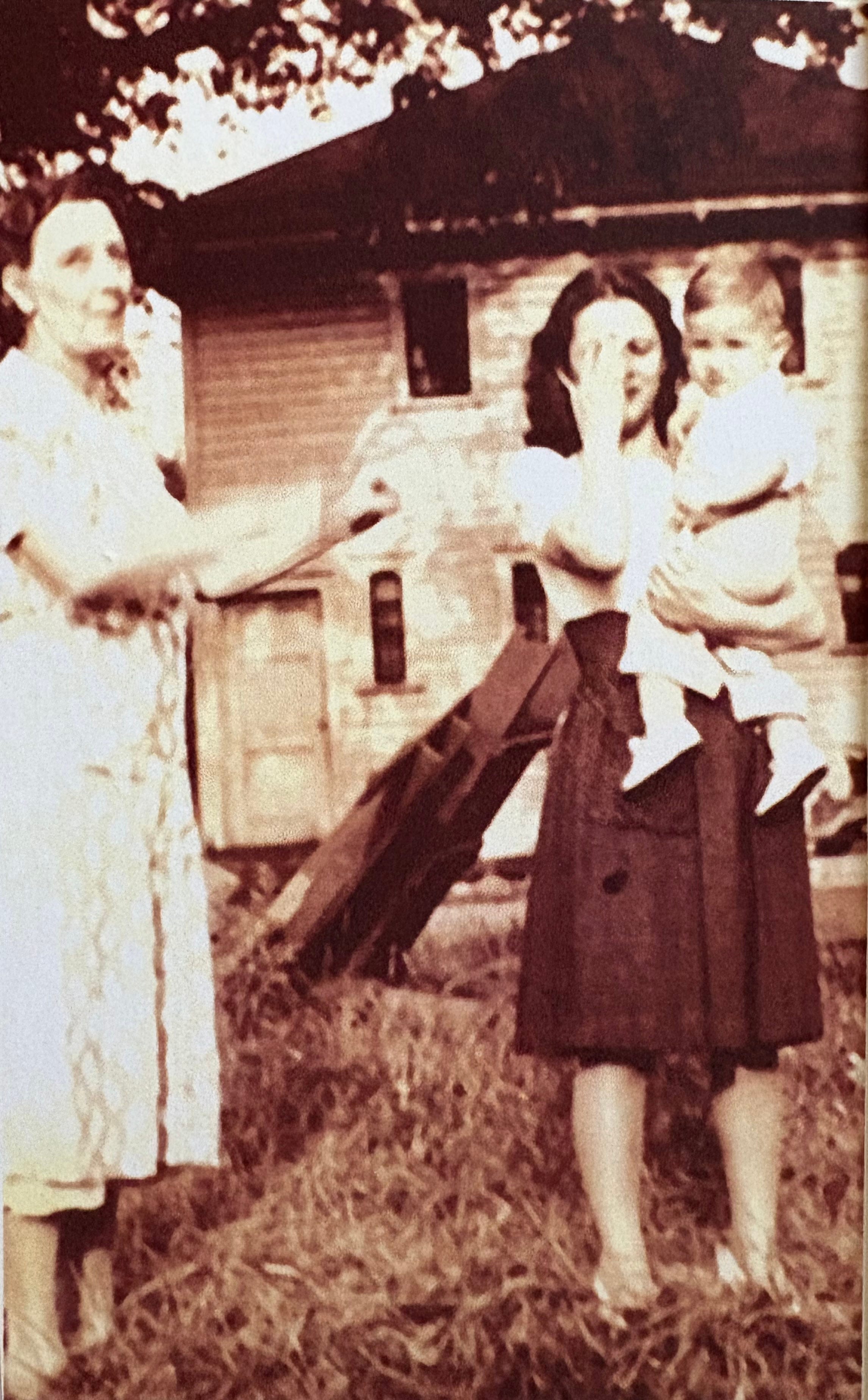
Like the house I grew up in, Dinkel’s Bakery where we purchased those maple cakes also no longer exists. I’ve tried to replicate the cake and have learned that some tastes will always stay a fond memory. The taste of that cake was influenced by a house, a bakery, and people that are all no longer here.
For many people home is a place. For others, it’s a feeling created by surroundings, things and people. But sometimes, home is a memory—of something we once had long ago. Like a tea party with an uncle in a white four square filled with people and love.
People we can trust to guide us back home when it’s time.
Michelle Adams writes Marygold Journal, a Midwestern field guide to aliveness in the modern world through philosophy, reflection, food and soil. After decades spent in high-pressure work and entrepreneurship, her writing explores what it means to leave survival mode and work on finding yourself again—through small rituals, careful observation, and a return to what has always been within reach. If you’ve ever wondered whether there’s another way to live—one that is slower, steadier and deeply your own—you’re in the right place.
Such a lovely piece, Michelle. Loved it 🙏🏻🌸