
Learning to Forget Time
What Happens When the Calendar Goes Dark but the Life You Escaped Still Lives Inside Your Nervous System

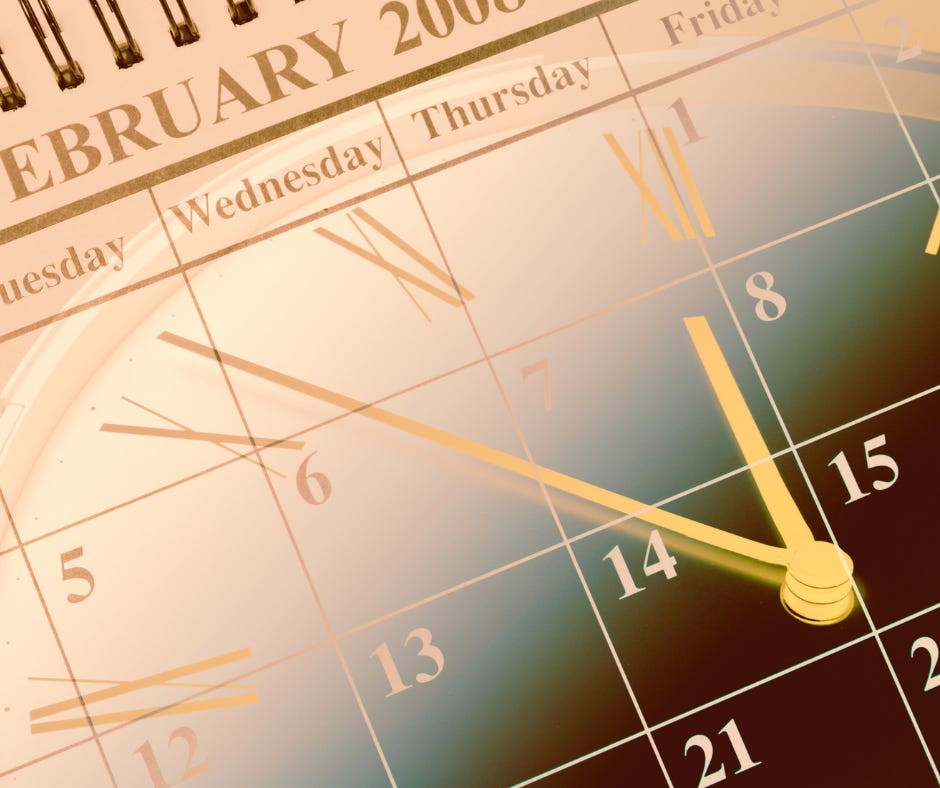
My husband reminded me this weekend is Memorial Day. I didn’t believe him.
I was always that person tied to their calendar—at least two paper versions plus two online. It may seem excessive, but it’s how I survived. For forty years the calendar dictated my life. In fact, I’ve saved many of my day planners, even the ones from college. I’ve found them useful as fragment artifacts to return to and reflect upon.
But now, I rarely refer to a calendar at all. In fact, I am ashamed to admit that many days I wake up not knowing what day of week it is without giving it some hard thought.
This is how much my life has changed. It makes me wonder if it’s like this now, what will it be like when I am actually of an age to retire altogether? Do the days matter when they are all the same? When you have nothing scheduled on the calendar, and nowhere to be?
Last week I messed up my doctor’s appointment and went half an hour early. I'm never early. Some may see arriving early as a good thing. But I've been a “right on time” girl my whole life. It was disorienting. I sat in the waiting room unsure if I should simply leave and go back home since I literally live down the block from the medical center. I decided to stay thinking I’d get called early. I didn’t.
This is one of the reasons I like to be right on time. It’s just easier.
So, another thing I will admit is that I am a Walking Dead fan. You know that zombie show? I have loved zombie movies since I was in the sixth grade and saw the Night of the Living Dead. I had one of the best days of my life that day. My childhood best friend and I had walked all the way to main street from my house—hitting the candy store, the toy store, and the ice cream shop. Later that night we slept over at my Grandma’s house, watching TV until nearly dawn, high on sugar.
I just remembered laughing until it hurt. The entire day. Quite honestly, who laughs that much anymore? I’m midlife and my memory isn’t the same as it used to be. But I remember that day vividly, and there has to be a reason for that.
Anyway, back to the Walking Dead. There’s a scene in the first season when Dale talks about the importance of keeping time, even after the world has seemingly collapsed. He retells a story of a father handing his watch down to his son. The father says he is doing so not for the son to remember time, but so he can forget it, and not spend all of his breath trying to conquer it.
That’s the niggle in the back of my mind. The one that understands I spent forty years trying to conquer time. Rushing to get to work on time, to appointments on time, home on time. Even my kids were cared for according to time: 6 pm dinner time, 7 pm bath time, 8 pm bedtime. The alarm clock was set for a pre-sunrise wake up time. In the middle of the night during frequent bouts of insomnia, the hours were counted to determine how much time was left to sleep. Then the wake-up rush to get myself ready, get the kids ready and get out the door. On time.
Is that really how we are supposed to live? It doesn’t seem right. It seems more like forcing our nervous systems to obey a calendar dictated by modern society while ignoring an older wisdom within us—the quiet rhythm of light and dark, wake and rest, season and slowness. An internal clock far older than ambition, inboxes, deadlines and alarm clocks. And far wiser.
I get it. We live in modern society. We need to pay the bills, go to work, and go to appointments. Therefore, we need to know what time and day it is. In fact, one could argue that if we fail to live according to society’s set times, mass chaos could erupt.
Perhaps.
Or maybe we’d all feel a little lighter. More at peace. Because that need to do things by a certain date, a certain time, it negatively affects our nervous system.
I cannot express the amount of dread I lived under for decades. It was like a raincloud perpetually over my head. That dread was caused by looming obligations on my calendar and trying to get to places on time. Court in the morning, and a deposition in the afternoon. Back to the office to work on the pleadings, discovery and briefs piled on my desk. Return emails and phone calls before heading home at night. Then, after the kids go to bed, prepare for the next day.
If you’re not familiar with litigation, this is the life of a litigator. This frantic pace never stops. This is why you need four calendars. The goal is a clean desk and empty inbox. The goal is never achieved because the goal is an illusion. They call it a caseload for a reason.
It’s the type of job that wakes you in the middle of the night. Keeps you up. Gives you the Sunday scaries.
I was good at what I did because I paid the price to do it. That price was time. If asked to describe myself then, it was usually with “expert multitasker” in the headline. In fact, I wore it like a badge of honor. Since then I have learned that multitasking isn’t a badge. It’s a chronic state of divided attention.
Presence is foreign to multitaskers. And presence is the key to peace.
But that’s not my lifestyle any longer. Some people may take my “no need for a calendar” life as one to be coveted. It’s not. Yet. There’s a lot of work that goes into the transition. Apparently when you’ve lived one way for decades, it’s much harder than you would think to simply turn it off.
I used to believe a full calendar meant I mattered. While a filled calendar can cause anxiety, it also signals importance. I felt worthy when my calendar was filled. Now, I don’t.
Empty space on the calendar feels irresponsible. Wasteful. If no one needs me, who exactly am I? If there is nothing on the calendar, am I being productive? If I am not producing, what’s my purpose? I look at the blank calendar and go to check MyChart to see what appointments I can add to it. I sit and wonder if this will change. If I’ll be able to make something of my quieter life and this writing that will allow me to feel the way I used to. Needed. Worthy.
This is me on the threshold. This is what it feels like to be in between two versions. The one I was desperate to leave. The other I have not fully arrived in yet. But I do know how I want it to feel when I finally arrive. Purposefully rhythmic.
You know how it feels to go on a beach vacation and have no plans? Your day is laying on the beach with a good book in one hand and a pina colada in the other. Everything about the day is just natural rhythm. Maybe you’ll read the book, or maybe you’ll sit and stare at the sea. Maybe you’ll order another drink, or maybe you’ll take a nap. Maybe you’ll get up and walk the beach, or maybe you’ll take a swim. In the afternoon you’ll go in and get ready for dinner. Dinner makes it so you’re just busy enough.
Why is this rhythm reserved for vacations? Why are we not expected to be productive on the beach, but at home we must frantically strive to meet society’s demands? Then after years of living according to the modern clock, we get to the point where we want to make a different choice and slow down. But the unfilled calendar says we aren’t worthy.
I don’t know the answers to the questions. I’m just here to ask them and work my way through them. The one thing I am sure of is that I want to live according to an older rhythm that has been quietly calling me home my whole life. Perhaps that’s why nothing ever fully fit. I kept searching for a role, a title, a version of success that felt like me, when maybe what I was looking for was something simpler: a life I could inhabit. To uncover my true rhythm, but also, my reason for being.
I don’t know where I’m going next. Or how to get to the version I want to be in. Unfortunately you don’t always close one door and walk through another. Sometimes you pause on the threshold. That’s what I am doing. Right now, I’m hovering. It’s uncomfortable for someone like me who always had a filled calendar to direct her. I really want to be excited about having nothing penciled in every moment of my day. My nervous system just hasn’t caught up to where I am yet. It’s still in the life I left trying to convince me that my worth will only exist there.
Perhaps I’ll bring it to trial soon with the purpose of proving to my nervous system that it can learn to exist without a calendar telling you who you are. This is the work of becoming that we don’t often hear about. The work is reconstructing identity, which can be a full time job. Lingering on the threshold, waiting to walk through a door. Perhaps not so dissimilar from sitting in a waiting room and learning to just be.
I am learning that studying life in order to redesign it doesn’t require outside deadlines and a full calendar. It involves learning how to occupy time differently. Being uncomfortable with the unfamiliar. And maybe that’s ok for now.
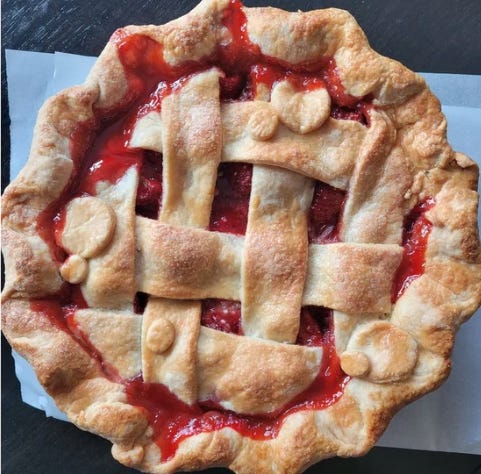
Anyway, as it turns out, this weekend is indeed Memorial Day after all. I decided to put a cookout on the calendar and make a Strawberry Pie.
Full recipe coming Sunday—because you know how much I love pie, and hopefully you do as well.
Michelle Adams writes Marygold Journal, a Midwestern field guide to aliveness in the modern world through philosophy, reflection, food and soil. After decades spent in high-pressure work and entrepreneurship, her writing explores what it means to leave survival mode and work on finding yourself again—through small rituals, careful observation, and a return to what has always been within reach. If you’ve ever wondered whether there’s another way to live—one that is slower, steadier and deeply your own—you’re in the right place.